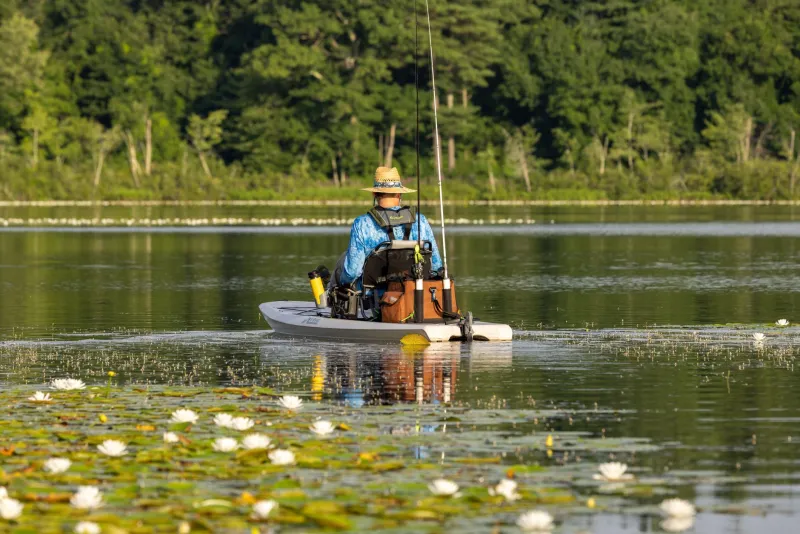
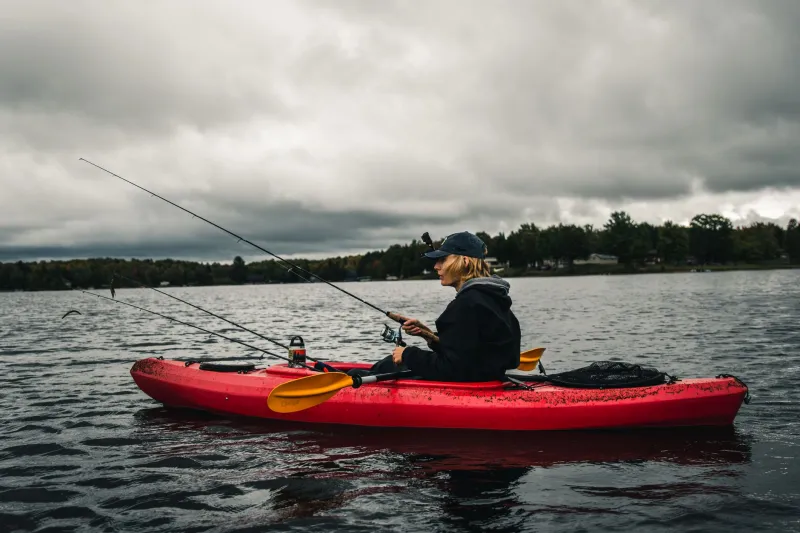
Quiet Water, More Bites: What Your Kayak Is Telling the Bass Before You Even Cast

You've got the right lure. You've read the structure. You've eased into position without a ripple. And then your paddle bangs the gunwale, your tackle tray rattles like a tin can, and every largemouth within thirty feet disappears into the weeds.
Sound travels four times faster through water than through air. Bass have a lateral line system — a row of pressure-sensitive cells running the length of their bodies — that picks up vibrations the same way ears pick up sound waves. They're not just hearing the splash. They're feeling the low-frequency hum of your hull dragging through the water column. And the moment something feels wrong, they shut down.
Noise management is the missing piece for a lot of kayak anglers. You can dial in your technique, upgrade your rods, and tie perfect knots all day long, but if your rig sounds like a rolling tackle shop, you're fighting an uphill battle every single cast.
What Bass Actually Hear (And Why It Matters)
Largemouth bass are wired for acoustic information. Their lateral line and inner ear work together to build a real-time picture of what's happening around them — movement, vibration, pressure changes. Research out of fisheries biology programs has consistently shown that bass respond to low-frequency disturbances in the 10–200 Hz range, which is exactly where kayak hull vibrations, paddle slaps, and gear rattles tend to live.
Here's the frustrating part: the sounds that spook fish are rarely the dramatic ones. You're not blowing your cover by dropping a rod. You're blowing it by the constant, low-grade hum of a plastic hull skimming across a shallow flat, or the faint tap-tap-tap of a carabiner swinging against your seat frame every time you shift your weight.
Shallow water amplifies all of it. In less than four feet, sound bounces off the bottom and back up through the water column. That's exactly the environment where bass spawn, feed, and hold during the early morning hours when most kayak anglers are trying to capitalize.
The Loudest Offenders on a Typical Kayak
Before you can fix the problem, you need to know where the noise is coming from. Run through this list and be honest with yourself:
Paddle slap. The single loudest thing most kayak anglers do. When a blade enters or exits the water at a bad angle, it creates a sharp impact that sends a shockwave straight down through the water column. It's not the splash on the surface that kills you — it's the pressure wave underneath.
Hull contact with structure. Bumping a dock piling, grazing a submerged log, tapping a boat ramp — every one of those sends a vibration through your hull that bass can feel from a surprising distance.
Loose gear and tackle organization. Tackle trays with loose hooks, rod holders that rattle, carabiners clipped to D-rings, dry bags shifting around in the bow — all of it contributes to a constant background noise that follows you wherever you paddle.
Anchor systems. Dropping a stakeout pole, dragging an anchor chain, even the mechanical click of a drift chute deploying — these are loud events in a quiet underwater world.
Your own movement. Shifting in your seat, repositioning your feet, reaching across the hull for a rod — the creaks and pops of hull flex under a moving body add up quickly.
Practical Fixes That Actually Work
Modify Your Paddle Technique
The low-angle paddle stroke is your best friend for silent water. Keep your blade angle shallow on entry, slice it through the surface rather than stabbing it in, and feather your exit so there's no drip or slap on recovery. Practice on flat water until it feels natural. It's slower than a high-angle touring stroke, but that's fine — you're hunting, not racing.
For the final approach to a target zone, switch to a rudder stroke or a simple palm-roll to reorient the yak without any paddle-to-water contact at all.
Foam It Out
Open-cell foam is cheap and it's one of the best acoustic investments you can make. Line the interior of your rod holders with a thin strip of foam. Add foam padding wherever two hard surfaces can contact each other — around your tackle tray clips, along the inside of your gunwales, under any gear that sits on the hull deck. You can buy adhesive-backed foam weatherstripping at any hardware store for a few bucks and spend an afternoon eliminating a dozen rattle sources.
Rethink Your Anchor Setup
Ditch the chain. Seriously. A simple foam-tipped stakeout pole pushed quietly into a soft bottom is nearly silent and keeps you locked on a target without the clang and drag of traditional anchoring. For current situations, a mesh drift sock deploys softly and slows you down without the mechanical noise of a hard anchor.
Organize for Silence
Every loose item in your kayak is a potential noise source. Zip your dry bags. Clip carabiners through something solid so they don't swing. Use hook-and-loop straps to secure rods in their holders instead of relying on friction alone. A well-organized yak is a quiet yak, and a quiet yak is a deadly one.
The Final Approach Protocol
Once you're within casting range of a target — a laydown, a dock edge, a grass point — stop paddling entirely. Let momentum carry you the last ten to fifteen feet. If you need to adjust, use a single, slow sweep stroke. Give the water thirty seconds to settle before your first cast. That half-minute of patience can be the difference between a fired-up bass and one that ghosted the moment you arrived.
The Payoff Is Real
Anglers who start paying attention to acoustic discipline almost always report the same thing: they start catching fish in spots that used to go cold on them. The structure hasn't changed. The fish haven't moved. The only thing different is that they stopped announcing themselves.
Bass in pressured water are especially sensitive to this. Heavily fished public lakes are full of fish that have been spooked by boat motors, trolling motors, and clumsy kayak approaches so many times that they've learned to associate certain sounds with danger. Coming in quiet doesn't just help you catch more fish — it helps you catch the fish that everyone else is training to be uncatchable.
Paddle out. Go silent. Let the bass wonder where you came from.