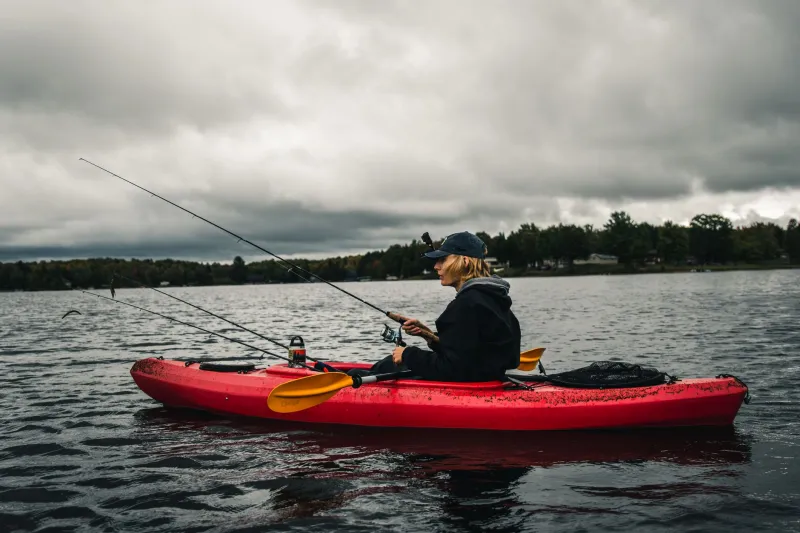
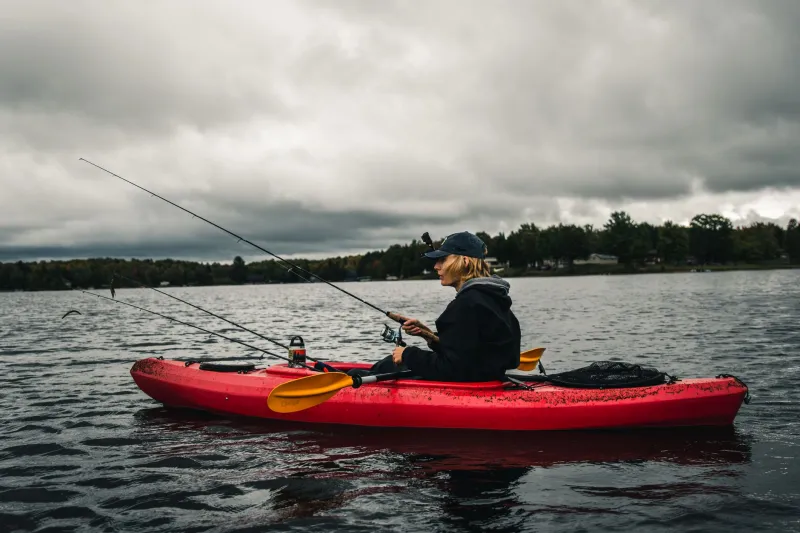
Get Dirty, Get Close, Get Bit: Mastering Flipping and Pitching from a Kayak

There's a reason tournament bass anglers spend thousands of dollars on trolling motors designed to move their boats quietly. They're chasing the same advantage kayak anglers get for free.
Silence. Stealth. The ability to slide right up on a brushpile, a dock, or a gnarly mat of lily pads without telegraphing your arrival. Powerboat guys have to work hard and spend big to approximate what you can do naturally from a yak. And nowhere does that edge show up more clearly than when you're flipping and pitching heavy cover.
If you haven't dialed in these techniques yet, buckle up. This one's going to change the way you fish.
What's the Difference Between Flipping and Pitching?
These two terms get used interchangeably a lot, but they're actually distinct techniques — and both have a place in your kayak game.
Flipping is the ultra-close-range move. You're talking about presentations inside 10 to 15 feet. You let out just enough line to match the depth you're targeting, hold the excess in your non-rod hand, and use a pendulum swing to drop your bait straight down into a specific spot with almost zero disturbance. It's surgical. When you're parked three feet from a dock piling or easing up alongside a laydown, flipping lets you thread the needle into gaps that a cast could never reach cleanly.
Pitching extends your effective range out to about 30 or 40 feet while keeping the same low, quiet trajectory. Instead of a traditional overhead cast, you load the rod tip by dropping the bait and using a smooth underhand motion to sling it forward. The bait skims low and lands soft — which is exactly what you want when you're targeting skittish fish tucked under structure.
Both techniques demand accuracy over distance, and both reward patience and practice. But here's the thing: from a kayak, you're already cutting the required range in half compared to what a boat angler needs to manage. That makes learning curves shorter and presentations tighter.
Why the Kayak Changes Everything
Let's be real. A lot of the best bass in any given body of water are living somewhere that's genuinely hard to fish. Under a dock that's three feet off the water. In the back of a flooded creek arm choked with fallen timber. Underneath a mat of vegetation so thick it looks like a solid surface.
Big bass didn't get big by being dumb. They use that cover as armor, and they spook fast when something feels off. A boat motor — even a quiet electric one — creates pressure waves and vibration that travel through the water well before the boat arrives. By the time a powerboat angler gets into casting range, the fish has often already moved.
A kayak? You're paddling with your hands. You're low to the water. You can stop moving and just drift the last few feet on momentum alone. The fish doesn't know you're there until your bait hits the water — and by then, it's too late.
That low-profile approach is the ultimate setup for flipping and pitching. You're already close. You're already quiet. The technique and the platform were basically made for each other.
The Right Cover to Target
Not all structure is created equal. When you're running a flip-and-pitch approach from a kayak, prioritize these three types of cover:
Docks and boathouses — The shaded water underneath a dock is prime real estate for largemouth, especially in warm weather. From a kayak, you can ease right up alongside the dock and flip directly under it without bumping into anything or making noise. Target the corners, the posts, and especially any cables or chains running into the water.
Laydowns and fallen timber — A big tree that's fallen into the water creates a whole ecosystem of ambush points. Work methodically from the outer branches toward the trunk, flipping into every pocket and gap. The fish are usually tightest to the wood, so don't be shy about getting your bait right against the bark.
Vegetation mats — Thick pads, hydrilla mats, and surface vegetation are absolute money for big bass, but they're notoriously hard to fish effectively. A heavy punching rig dropped straight down through a hole in the mat is often the only way to get bit. From a kayak, you can position yourself directly over the sweet spot and punch straight down with a flip, which is way more effective than trying to angle a cast through the canopy from 30 feet away.
The Gear Setup That Gets It Done
Flipping and pitching from a kayak is close-quarters, heavy-cover work. Your tackle needs to match that reality.
Rod: You want a heavy or extra-heavy power rod in the 7-foot to 7'3" range. Longer rods give you more reach on the flip and more leverage to horse fish out of thick cover before they can wrap you up. Brands like Ugly Stik, Daiwa, and Dobyns all make solid options in the $80–$200 range that won't break the bank.
Reel: A baitcasting reel is the standard choice here. Look for a low gear ratio — something in the 6.3:1 to 7.1:1 range — which gives you the cranking power to control a big fish in tight quarters. The Abu Garcia Revo Beast and Lew's Tournament Pro are popular picks that anglers trust in heavy cover situations.
Line: Don't mess around with light line here. Braided line in the 50 to 65-pound range is the go-to for punching mats and working thick wood. Braid has zero stretch, so you get immediate hooksets, and it cuts through vegetation instead of getting tangled up in it. If you're working cleaner cover like docks, some anglers prefer 17 to 20-pound fluorocarbon for its invisibility and abrasion resistance.
Baits: Heavy jigs in the 3/4 to 1-ounce range are classics for a reason. Creature baits, beaver-style soft plastics, and punch rigs rigged on 3/0 to 5/0 heavy-wire hooks all produce. Match your weight to the thickness of the cover — heavier for denser mats, lighter for more open wood and dock situations.
A Few Tips to Sharpen Your Game
Practice your flip and pitch in the yard before you're on the water. Seriously. Set up a hula hoop at 10 feet and another at 30 feet and work on dropping your bait into them consistently. Accuracy is the whole game with these techniques.
Use your paddle to control your position silently rather than reaching out and grabbing the dock or a branch. Grabbing structure transfers vibration directly to the fish's environment. A gentle back-paddle to hold position is almost always quieter.
When you flip or pitch, watch your line. A lot of bites happen on the fall, and the only sign you'll get is the line going slightly slack or moving sideways before the bait hits bottom. Stay dialed in.
Finally, don't rush. The whole point of getting close is to work the cover methodically. Give each spot a few seconds after the bait lands. Let the bait settle. Sometimes the fish just need a moment to commit.
The Bottom Line
Flipping and pitching are techniques that reward patience, precision, and positioning — and on a kayak, positioning is your built-in superpower. You can get into spots that powerboat anglers can't reach, approach cover that other anglers blow out, and make presentations so accurate and quiet that big bass simply don't see them coming.
That's not a small advantage. That's the whole ballgame.
Gear up right, practice the mechanics, and start targeting the nastiest, thickest, most ignored cover on your home water. The bass that live there are used to being left alone. They won't be ready for you.