Sit-On-Top vs. Sit-Inside Kayaks: One Style Wins for Bass Fishing and It's Not Even Close
Sit-On-Top vs. Sit-Inside Kayaks: One Style Wins for Bass Fishing and It's Not Even Close
Let's skip the part where we tell you "both styles have their place" and leave you more confused than when you started. That kind of fence-sitting might work for lifestyle blogs, but it doesn't help you make a $1,200 buying decision. You want a real answer, so here it is upfront:
For bass fishing in the American South — and honestly for most bass fishing scenarios in the US — a sit-on-top kayak wins. Decisively.
Now let's actually explain why, because the reasoning matters more than the conclusion.
What We're Actually Comparing
Before we get into the weeds, it's worth being precise about what these two hull styles actually are, because the terminology trips people up.
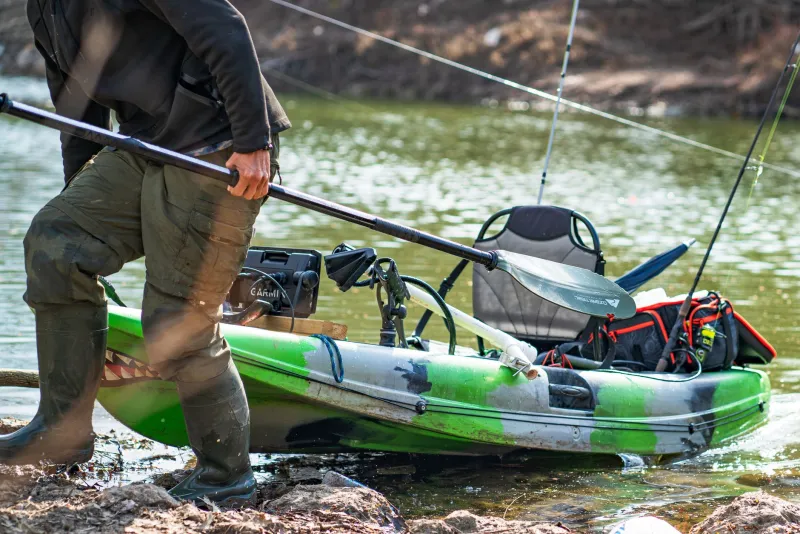
A sit-on-top (SOT) kayak has an open, molded deck. You sit on top of the hull rather than inside it. The cockpit is an open well, usually with a molded seat and adjustable footrests. These kayaks are self-bailing — small scupper holes in the hull drain water automatically. Most modern fishing-specific kayaks, including popular models from Hobie, Jackson, and Old Town, are sit-on-tops.
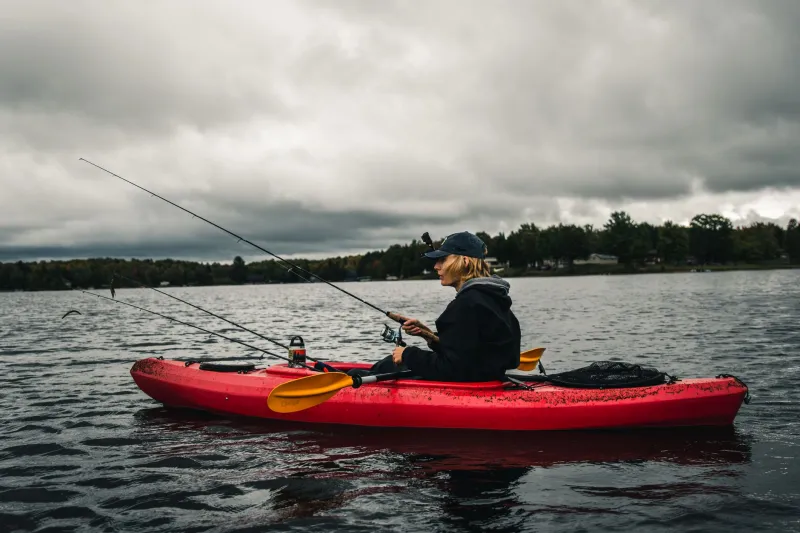
A sit-inside (SINK) kayak has an enclosed cockpit. Your legs are inside the hull, protected from the elements. They're drier, typically faster due to lower wind profile, and often more efficient to paddle over long distances. You'll find them everywhere from whitewater rivers to ocean touring.
Both styles catch fish. But when you line them up against the specific demands of bass fishing — casting mechanics, gear access, stability under load, and behavior in the environments where bass actually live — one style handles the job significantly better.
Casting: The Movement Problem
Here's something that doesn't get discussed enough in kayak fishing content: casting from a kayak isn't just about throwing a lure. It's about generating power and accuracy while your body is in a compromised, seated position, often with a slight rocking motion beneath you.
On a sit-on-top, you can rotate your torso freely. You can brace your feet against the footrests and engage your core. Some SOT fishing kayaks are wide enough and stable enough that experienced anglers stand up to cast — a practice that's become standard in tournament kayak bass fishing. Standing dramatically improves sight fishing, casting angle, and lure control.
In a sit-inside, your legs are locked inside the hull. Torso rotation is limited by the cockpit rim. Standing is technically possible on some wider SINK designs, but it's awkward at best and genuinely risky on anything narrower than about 28 inches. The enclosed cockpit that makes SINKs feel secure on open water is the same thing that makes them frustrating casting platforms.
For a style of fishing that requires repeated, precise casts into tight cover — dock pilings, laydowns, grass edges — that mobility difference is enormous.
Stability: Wide and Flat Wins the Bass Fishing Game
Bass fishing rarely happens on glassy, calm water. Wind-blown reservoirs, tidal push in coastal marshes, current seams on river systems — the conditions vary constantly, and your platform needs to handle them without requiring your full attention just to stay upright.
Modern fishing-specific SOT kayaks are designed with primary stability as a priority. Hulls like the Old Town Sportsman PDL 120 or the Jackson Coosa X are wide, flat-bottomed designs that feel almost unnervingly stable when you first get on them. That stability comes at a cost in terms of top-end speed, but for bass fishing — where you're covering water slowly and methodically — speed is rarely the limiting factor.
 Photo: Jackson Coosa X, via media1.popsugar-assets.com
 Photo: Old Town Sportsman PDL 120, via i.pinimg.com
SIT-inside kayaks, especially touring designs, prioritize secondary stability. They feel tippy at rest but stiffen up as you lean into a brace. That characteristic works beautifully for paddling through rough water efficiently. It works much less beautifully when you're trying to land a four-pound largemouth with a treble-hook lure, manage a net, and keep your tackle tray from sliding off the deck simultaneously.
Wind-blown reservoirs: SOT wins. The lower center of gravity and wider hull handle beam wind more predictably than most SINK designs.
Tight creek channels: This one is closer. SINK kayaks are often narrower and more maneuverable in confined spaces. But the casting limitation still applies, and the best creek channel SOTs — shorter, wider designs — compete well here.
Gear Storage: This Isn't Even a Contest
Bass fishing requires more gear than almost any other style of kayak angling. Multiple rod setups, tackle trays, soft plastics in a dozen colors, electronics, a net, a fish finder, snacks, a dry bag, a PFD, and — if you're tournament fishing — a live well or aerated cooler.
Sit-on-top fishing kayaks are built around this reality. They have open rear tank wells that can swallow a milk crate loaded with rod tubes without issue. The bow typically has a covered hatch for dry storage. The open deck can be rigged with RAM mounts, rod holders, and accessory rails in almost any configuration. Aftermarket customization is a whole subculture.
Sit-inside kayaks store gear inside the hull, accessed through hatches. This works great for touring — your dry bags stay dry and your center of gravity stays low. For bass fishing, it's a logistical nightmare. Imagine stopping mid-retrieve to dig a different color plastic worm out of a hatch that's behind your hip. You won't do it twice before you start leaving gear at home, which defeats the purpose.
Stealth: Surprising Results
Conventional wisdom says sit-inside kayaks are stealthier because they ride lower in the water and have a smaller visual profile. There's some truth to that in open water situations.
But bass fishing stealth is mostly about sound and water displacement, not silhouette. Both hull styles, paddled carefully, can approach shallow bass without spooking them. The bigger stealth factor is angler behavior — splashy paddle strokes, dragging gear across the hull, banging a rod butt against the boat. Those variables exist regardless of hull style.
Where SOT kayaks actually have a stealth advantage is in pedal-drive systems. Hobie's MirageDrive, Native Watercraft's Propel system, and similar pedal drives are almost exclusively found on sit-on-top designs. Hands-free propulsion that lets you maintain position, adjust angles, and cover water while keeping both hands on the rod is a genuine game-changer for bass fishing stealth and efficiency.
When Sit-Inside Kayaks Actually Make Sense
Fair is fair — there are scenarios where a SINK earns its place.
Cold-weather fishing in the upper South and Appalachian foothills is one of them. When water temps drop below 50°F, immersion risk becomes serious. A SINK with a spray skirt keeps your lower body dry and warm in a way that an SOT simply can't match. If you're chasing smallmouth in Tennessee rivers in February, a quality SINK with appropriate cold-water gear is a reasonable choice.
Long-distance access paddling is another scenario. If the bass fishing spot you want to reach requires a three-mile paddle across open water, the efficiency advantage of a narrow SINK hull adds up over distance.
But these are edge cases. The majority of bass fishing situations — reservoir fishing, river systems, marsh flats, farm ponds, backwater sloughs — play directly to the SOT's strengths.
The Bottom Line
If you're building a kayak setup around bass fishing and you're trying to decide between these two hull styles, buy a sit-on-top. Specifically, look for a fishing-oriented SOT in the 12-to-14-foot range with a minimum beam of 32 inches, a quality adjustable seat, and a rear tank well large enough for a milk crate. Budget for a pedal drive if you can swing it — you'll wonder how you ever fished without one.
Sit-inside kayaks are excellent boats for what they're designed to do. Bass fishing just isn't their primary job, and no amount of accessory rigging changes the fundamental casting and storage limitations of the enclosed cockpit.
Paddle out, cast deep, and stop second-guessing the hull choice. The fish are waiting.