You're Reading the Water All Wrong — Unless You're in a Kayak
You're Reading the Water All Wrong — Unless You're in a Kayak
There's a moment every kayak angler knows. You're drifting slow over a flat, paddle blade barely kissing the surface, and you can see it — a submerged timber pile, a hard grass edge, a subtle shelf dropping off into dark water — all of it invisible to the guy standing on the bank fifty yards away, and completely overlooked by the bass boat that blew through here an hour ago at 40 mph.
That moment isn't luck. It's geometry. It's physics. And honestly, it's one of the best-kept secrets in freshwater fishing.
Kayak fishing isn't just a budget workaround for people who can't afford a Ranger. It's a genuinely different — and in many ways superior — way to understand bass habitat. Here's why, and more importantly, how to use it.
The Low-Profile Advantage Nobody Talks About Enough
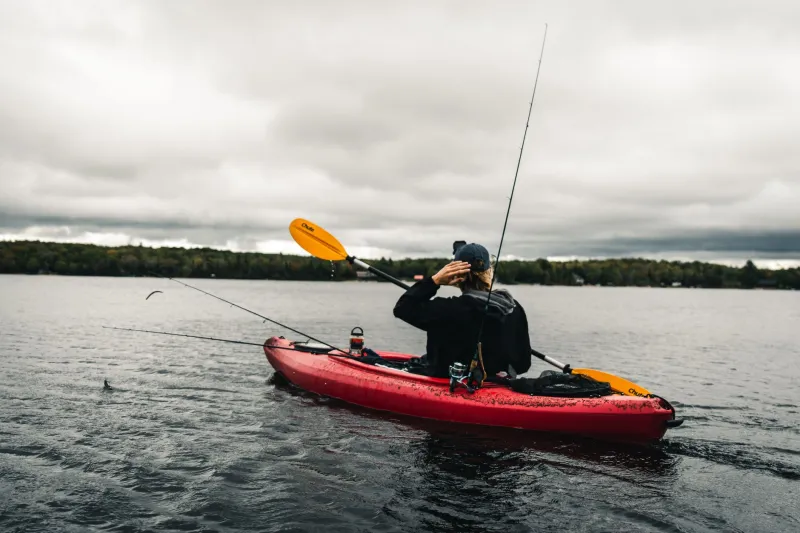
Sit in a kayak and think about your eye level. You're maybe 18 inches off the water on a sit-on-top, maybe a foot on a sit-inside. Compare that to a standing angler on a dock, or someone perched on the casting deck of a bass boat. The angle at which light hits the water changes everything about what you can and can't see beneath the surface.
At low angles, especially in early morning or late afternoon light, the water's surface becomes more transparent. Polarized sunglasses amplify this dramatically. From a kayak, you're essentially looking through a window. From a bank or a raised boat deck, you're more often looking at a mirror.
This means structure that's invisible to everyone else is readable to you — if you know what to look for.
What You're Actually Looking For
Bass relate to structure the way commuters relate to highways. They use it to navigate, ambush prey, and regulate body temperature. The trick is finding those highways before you start casting.
Submerged timber is one of the most reliable bass magnets in any reservoir, and kayaks are uniquely suited to finding it. Flooded creek channels in impoundments are loaded with old treelines, brush piles, and root systems. From a kayak, you can ease into water too shallow for a motorboat and actually peer down through the surface to spot these features. Look for color changes — dark patches against a sandy bottom, irregular shadows, or the faint outline of a trunk running parallel to a drop.
Grass edges are another story entirely. The transition zone where submerged vegetation meets open water is one of the most productive spots in bass fishing, but that edge is rarely a straight line. It meanders, it thickens and thins, it has pockets and points. A kayak lets you follow that edge slowly, adjust your position in real time, and cast parallel to it — angles that are physically awkward or impossible from a bank.
Drop-offs and depth changes are harder to see visually, but a kayak gives you a tool most anglers overlook entirely: your paddle.
Using Your Paddle to Read the Bottom
This is a technique that doesn't get nearly enough attention. When you're moving slowly through unfamiliar water, your paddle blade can tell you a tremendous amount about what's below.
Dip the blade straight down and feel for resistance. Sandy bottom feels firm and immediate. Muck or silt gives you a slow, sinking push. Rock is hard and sharp. Gravel is gritty. None of this is complicated — it just takes practice and intention.
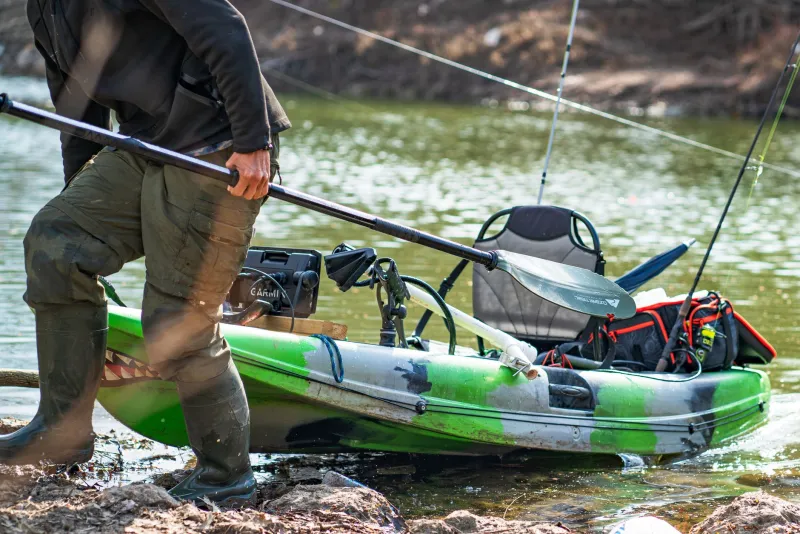
More importantly, you can use the paddle to probe depth changes. In stained or murky water where you can't see structure visually, a slow sweep of the blade as you drift can reveal a sudden depth increase (blade drops freely) or a hard shelf (blade contacts bottom at an unexpected angle). Pair this with a basic fish finder mounted on your yak and you've got a scouting system that would cost thousands of dollars to replicate on a motorboat — and still wouldn't give you the same granular, slow-motion view.
Stealth Is Its Own Kind of Structure Knowledge
Here's something that doesn't fit neatly into a gear review or a technique breakdown, but it matters: bass behave differently when there's no boat pressure.
A trolling motor still makes noise. A hull still displaces water. Bank anglers spook fish with footsteps and shadows. A properly paddled kayak — slow, deliberate, no sudden movements — introduces almost no disturbance into the water column. That means the bass you're observing are acting naturally.
Watch where they hold. Watch where they move when a cloud passes over. Watch what they do at the edge of that grass bed as the sun angle shifts. You're not just fishing — you're doing fieldwork. And the data you collect from an undisturbed body of water is infinitely more useful than anything you'd see after a motorboat has run through the area.
Practical Tips for Scouting New Water From Your Yak
- Arrive early and don't fish immediately. Spend the first 20 minutes just paddling and observing. Mark waypoints on your GPS for anything that looks interesting.
- Work perpendicular to the bank, not parallel. You'll cross more structure types and get a better sense of depth changes.
- Use the wind. Drifting slowly with a light wind is often more effective than paddling. You cover water naturally and keep noise to a minimum.
- Look for transitions, not just features. The spot where hard bottom meets soft bottom, where open water meets vegetation, where shallow meets deep — those seams are where bass live.
- Trust your paddle. If the bottom composition changes under your blade, stop and fish that spot before you move on.
The Bigger Picture
Bank fishermen are limited by where they can stand. Bass boat anglers are limited by where they can safely run. Kayak anglers are limited by almost nothing — and that freedom to go slow, go shallow, and go quiet is what turns a fishing trip into a genuine education in bass behavior.
Every hour you spend in a kayak reading water makes you a better angler, full stop. Not just a better kayak angler. A better angler, period. Because once you understand how bass use structure from this vantage point, you'll never look at a body of water the same way again.
Paddle out. Read deep. The fish are right there — you just have to get low enough to see them.