Your Brain on Bass: The Science Behind Why Kayak Fishing Is Good for Your Mental Health

You already know that feeling. It's 6 a.m., the water is glassy, the air smells like pine and mud, and you haven't thought about your inbox in forty-five minutes. That's not just a good morning — that's your nervous system doing exactly what it was built to do. And if you've been fishing from a kayak for any length of time, you've probably noticed that you come off the water feeling lighter than when you launched.
Turns out, that's not just in your head. Well — it is in your head. That's kind of the point.
The mental health benefits of kayak bass fishing are real, they're documented, and they go a lot deeper than "being outside is nice." Let's break down what the science actually says.
Nature Exposure Lowers Cortisol — Full Stop
Cortisol is your body's primary stress hormone. When it's chronically elevated — which it is for a lot of Americans grinding through 50-hour work weeks — it wrecks sleep, tanks mood, and contributes to everything from anxiety to cardiovascular problems.
Research published in Frontiers in Psychology found that spending as little as 20 to 30 minutes in a natural environment significantly reduces cortisol levels. Not scrolling through nature photos. Actually being outside, in it.
Kayak fishing doesn't just put you in nature — it puts you in nature. You're on the water, surrounded by it, moving through it. There's no windshield between you and the morning fog. That's a fundamentally different experience than a walk around a parking-lot-adjacent park, and your brain responds accordingly.
Blue Mind: Why Water Specifically Changes Your Brain State
Marine biologist Wallace J. Nichols wrote a whole book on this — Blue Mind — and the core idea is that being near, in, on, or under water triggers a mild meditative state in the human brain. He calls it "blue mind," and it's the neurological opposite of the overstimulated, distracted state most of us walk around in all day.
Water environments reduce activity in the brain's default mode network — the part that's responsible for rumination, self-criticism, and the mental replay of every awkward thing you've ever said at a party. Being on the water quiets that noise.
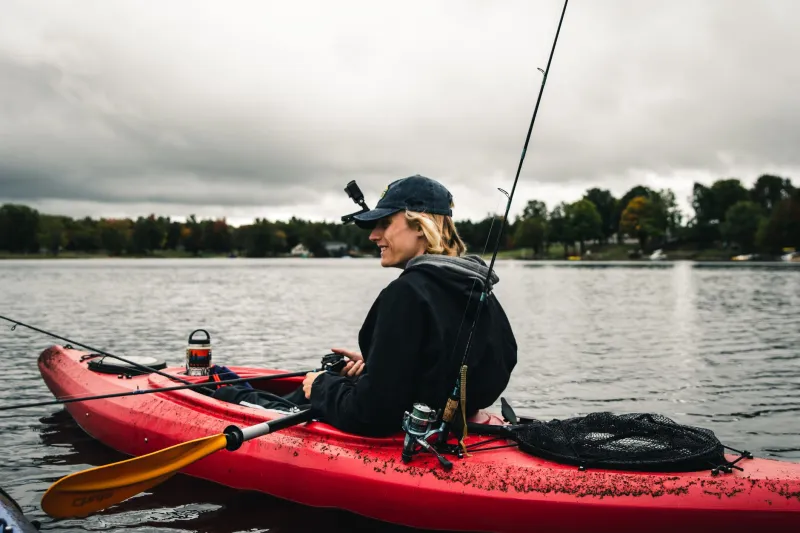
For kayak anglers, this effect is amplified. You're not just near water — you're inches above it. The sound of your paddle dipping, the subtle rocking of the hull, the reflection of cypress trees in still water — all of it compounds the effect. Your brain shifts gears in a way it almost never gets to during a normal workday.
Fishing Demands Presence — and Presence Is the Point
One of the hardest things to do in modern life is pay attention to what's actually in front of you. Mindfulness gets a lot of buzzword treatment, but the underlying science is solid: present-moment awareness reduces anxiety and improves emotional regulation.
Bass fishing from a kayak forces presence in a way that's hard to replicate artificially. You're reading the water. You're watching your line. You're adjusting for wind drift, tracking where your lure is in the water column, watching for the subtle twitch that means something just ate your drop shot. There's no mental bandwidth left for whatever you were spiraling about on the drive to the ramp.
This is sometimes called "flow state" — a concept developed by psychologist Mihaly Csikszentmihalyi — and it describes a condition of complete absorption in a challenging, rewarding task. Bass fishing hits every marker: it requires skill, offers feedback in real time, and balances challenge with the genuine possibility of success. Flow states are associated with reduced depression, improved mood, and a stronger sense of purpose.
The Dopamine Loop Is Real (And It's Healthy)
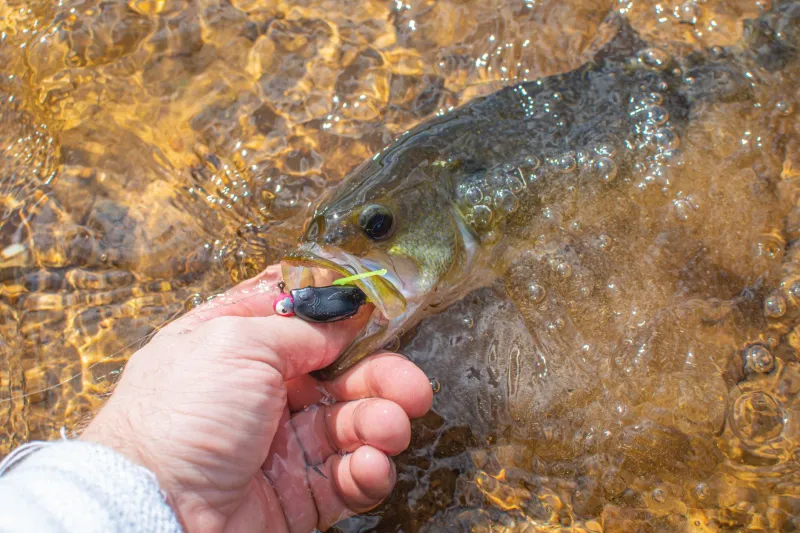
Every time you set the hook on a bass, your brain releases dopamine. That's not a metaphor — it's neurochemistry. Anticipation, pursuit, and reward are exactly the cycle that dopamine is designed to reinforce.
The important distinction here is that fishing-based dopamine hits come from a real-world, physically engaging activity rather than a screen-based shortcut. Scrolling social media also triggers dopamine, but in a way that's poorly regulated and often leaves people feeling worse afterward. Landing a largemouth on a topwater lure at first light? That's a dopamine hit with no hangover.
Over time, regularly engaging in rewarding, skill-based outdoor activities has been linked to improved baseline mood and greater resilience to stress.
Physical Movement Matters More Than You Think
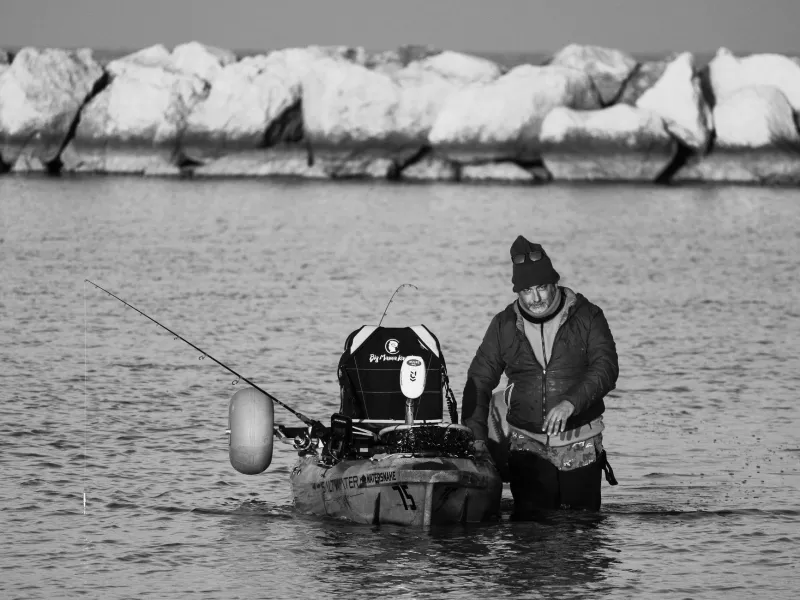
Kayak fishing isn't a passive sport. You're paddling to your spots, making hundreds of casts, repositioning constantly, and often fighting the wind to hold position on a flat. That's real physical exertion — and exercise is one of the most well-established tools for managing anxiety and depression.
The American Psychological Association notes that regular aerobic activity can be as effective as medication for treating mild to moderate depression in some individuals. You probably didn't pick up a kayak rod to treat your mental health, but the effect is there whether you planned for it or not.
Solitude Without Loneliness
There's a meaningful difference between being alone and being lonely. Kayak bass fishing — especially those early solo sessions when you're the only one on the lake — offers solitude in its healthiest form. You're self-reliant, purposeful, and connected to your environment. That combination tends to build confidence and a quiet sense of competence that carries back into everyday life.
For people dealing with social anxiety or general overwhelm, the kayak can become a genuine refuge — a place where the social scoreboard goes offline and you're just a person and a body of water and whatever's swimming in it.
You Don't Need a Prescription for This
None of this means kayak fishing cures anything. If you're dealing with serious mental health challenges, professional support matters. But as a supplement to a healthy life — or just as a reason to justify getting out on the water more often — the science is genuinely on your side.
The next time someone gives you grief for spending a Saturday morning on the lake instead of doing something "productive," feel free to explain that you're engaged in cortisol regulation, dopamine optimization, and mindfulness-based stress reduction.
Or just say you're fishing. Either works.